
Federal BOP Release Destinations
A federal prisoner may leave a BOP institution for the community, a residential reentry setting, supervision, or another authority. Federal supervised release is a court-imposed period in the community after incarceration; it is not the same as remaining inside a BOP prison. A detainer can instead cause delivery to a state, local, immigration, or other agency. In that event, BOP custody ends while confinement continues elsewhere.
That distinction is central for Allen County. A person transferred from the Allen County Detention Center to federal authorities was not released to the community at the local jail door. Conversely, a BOP locator result saying “Released” does not answer whether Kentucky, another county, or ICE later held the person. Follow the receiving agency named in the available transfer or release record.
| BOP result | Safe reading | Next check |
|---|---|---|
| Current institution | BOP reports present federal prison custody | Confirm through the listed institution |
| Released | BOP reports the federal prison term ended or custody ceased | Review date and other agency records |
| Not in BOP Custody | The person is not held by BOP | Check courts and possible receiving agencies |
| No match | The search did not identify a BOP record | Try identifiers, name variants, or another system |
Search Federal BOP Releases
The BOP Inmate Locator covers federal prisoners from 1982 to the present. The strongest search uses the eight-character BOP register number in the form #####-###. Other supported identifying numbers or a name search can also work. A name result displays the person’s name, register number, age, race, sex, release date, and location or status.
- Open the official BOP locator.
- Use the register number when known, or enter the person’s name.
- Compare all displayed identifiers before selecting a result.
- Read the release date together with the location or status.
- If the result says released or not in BOP custody, check for another custodian or supervision record.
Sentence computation can change a displayed date. The locator is strongest as an official federal custody indicator, not as a promise of a future gate time. A past release date gives a durable federal lead, but another agency’s record may be needed to learn what followed.
The official BOP locator page provides the federal-only search fields and status results. Its assigned capture appears below.
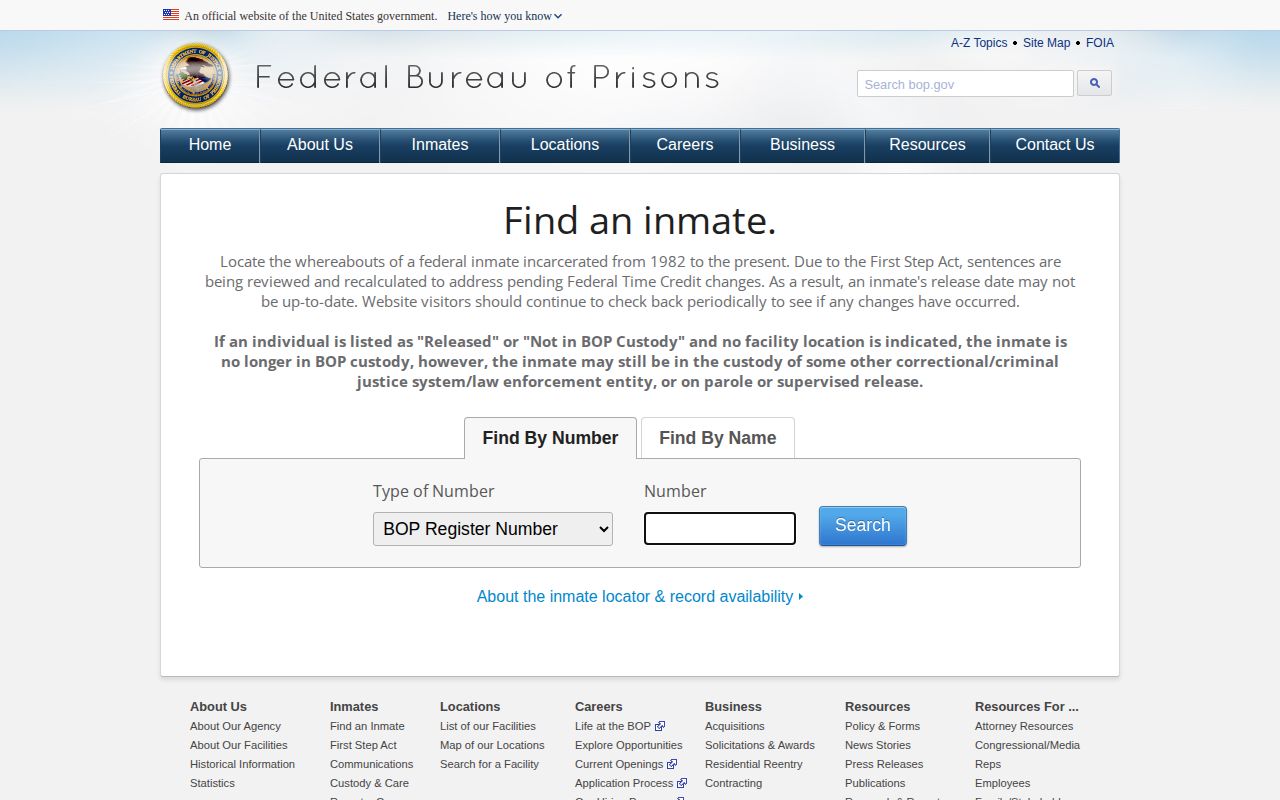
The image shows the correct federal search entrance. It is not an Allen County jail roster and should not be used for a routine local release.
Allen County Federal Release Limits
No BOP institution was identified inside Allen County. The BOP facility map entry exists because federal custody is a distinct release path, not because the county hosts a federal prison. Start with the legal custody class. A local arrest, bond, dismissal, or county sentence belongs in the jail release entry and Allen County court file. A Kentucky felony under state control belongs in KOOL and DOC Daily Releases. A federal sentence belongs in BOP.
A local jail can temporarily hold a person for another authority, but the building alone does not decide which search applies. Ask whether the Allen County record shows community release or transfer. If federal transfer appears, use the federal court docket for the case and BOP after designation. “Designation” is the process of assigning a sentenced federal person to a BOP institution.
The Allen County released inmate search lays out the local, state, and federal branches. Keeping them separate avoids a common error: interpreting disappearance from one agency’s list as freedom from all custody.
Federal BOP Release Records
The public locator supplies a limited result. BOP’s Notice of Release and Arrival form illustrates additional fields that can exist in federal release processing: name, release date and method, institution, register and FBI numbers, community release or detainer destination, transportation, supervision jurisdictions and contacts, proposed residence, and reporting instructions. The form is not a public name-search result.
Privacy rules restrict access to another living person’s federal file. Use the BOP Freedom of Information Act page for a formal request, and provide identity verification or authorization when required. Ask for identifiable existing records and give the register number, institution, and approximate release date when known. FOIA does not guarantee that protected material will be disclosed without redaction.
A court docket may offer more durable proof of the legal event that preceded or followed custody. A federal release order, judgment, or supervision condition answers a different question from the BOP locator. The locator addresses federal prison status; the docket supplies the court’s authority. Preserve both when exact timing and legal basis matter.
USMS and BOP Release Paths
The U.S. Marshals Service manages federal pretrial custody through local, state, private, and other contract beds. It does not provide an authoritative public former-detainee name search. USMS custody can end with acquittal, a court-ordered release, or transfer after sentencing and BOP designation. Search the federal court docket for the release order. Use BOP only after the person enters the BOP system.
This sequence explains why a BOP search may fail for a federal defendant who was held before trial. No BOP record is not proof of local release. The person may remain in USMS contract custody, may not yet have been designated, or may have left under a court order. Obtain the Allen County transfer entry if local custody was involved, then follow the federal docket.
If the BOP locator later shows “Not in BOP Custody,” read it narrowly. A state warrant, local detainer, or immigration transfer can still place the person elsewhere. The receiving system controls the next confirmation.
Federal Release Versus ICE Transfer
ICE is not BOP. Its Online Detainee Locator System uses a nine-digit A-number and country of birth, or exact first and last name plus country of birth and an optional birth date. ICE says its results can include current detainees and people released from ICE custody during the prior 60 days. After that short window, an absent result is inconclusive.
A transfer from BOP or the Allen County jail to ICE means the first agency’s custody ended, not that the person returned to the community. The ICE Detention Reporting and Information Line is 888-351-4024, Monday through Friday except holidays, from 8:00 a.m. to 8:00 p.m. Eastern, with language help. Use the separate ICE detention network page for that path.
Federal supervised release is also distinct from ICE supervision or detention. The court and supervising federal office are the sources for criminal supervised-release terms. The BOP locator should not be stretched beyond its prison-custody purpose.
Confirm Federal BOP Releases
Begin with the register number, name, and expected federal case. Save the BOP status and release date, then compare the federal court docket. If the result identifies no current BOP custody, look for a receiving authority, detainer, or supervision record before drawing a conclusion. Where Allen County held the person, request the local transfer or release entry for the destination.
Recent information can be incomplete. A projected date may change through sentence recalculation, and a transfer can close one custody record while another opens. For that reason, a sound confirmation uses at least two records: the BOP locator plus the federal docket, receiving-agency record, or official BOP response.
Identity checks matter with common names. Compare the register number, age, and other displayed traits, then preserve the federal case number when found. That case number is often the best bridge between the court judgment, custody history, and supervision terms. If two people have similar names, do not merge their dates or status. Search again with an identifier or a name variation.
Time also changes which channel is most useful. For a recent expected release, check the locator, court docket, and any named receiving agency. For an older event, the locator may retain the federal release date, while the docket supplies the lasting order or judgment. A formal BOP request can address missing correctional detail, subject to privacy and disclosure limits.